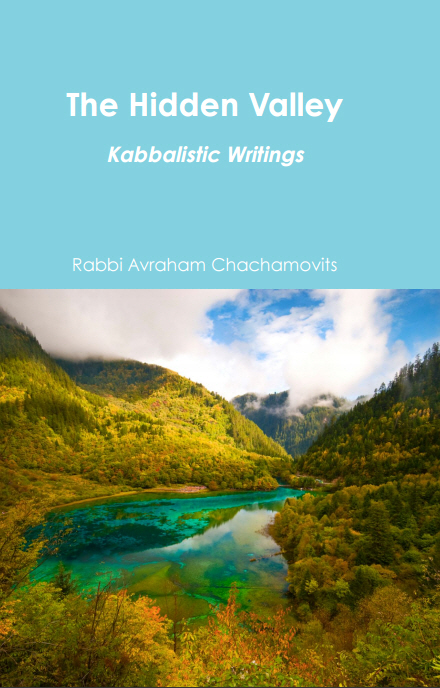
It is with great joy we announce the publishing of the new book from Rav Avraham Chachamovits, “The Hidden Valley – Kabbalistic Writings”. This very unique book brings a Kabbalistic commentary on Torah portions and related mystical subjects. Countless chidushim/novel ideas and very deep insights and analysis of Torah/Kabbalah, with hundreds of references to the Zohar and the Arizal. A work for serious students of mystical knowledge of the Kabbalah, filled with amazing revelations and new insights into the Torah.
“Topics range from Adam in Gan Eden, Nachash/Serpent, Tardemah/Deep Sleep of Adam, the Giants, the descendants of Adam, the Sheva Aratzot/Inner Earth, Telepathy, Erev Rav, Shadows/Tzelamim, the Sod of Tziniyut, Shemot Kodesh/Holy Names, Etz Chayim/Etz Da’at, Chanoch, Lot, Gilgulim/Reencarnations, Amalek, Shedim/Demons, Maggidim/Spiritual Guides, Ketoret/Incense, Nessim/Miracles, etc. With over 600 gematriot and 100 notarikon, this is a unique book: a tour de force in Kabbalistic thinking and spiritual insight.”
Publisher: Beit Arizal | Language: English | Volumes: 1 | Pages: 232 | Binding: Hard |
And it is written: כאשר צוה ה’ את משה ויפקדם במדבר סיני Ka’asher tsiva Hashem et-Moshe vayifkedem bemidbar Sinai, “As YKVK commanded Moshe, so he counted them in the wilderness of Sinai”[1]. See, this verse’s gematria is 2012, that is 4 x 503, this being the numerical value of המחנת ha-machanet, “the encampment”. And the parsha brings[2] how each one of the shevatim/tribes was positioned in the desert. There were four encampments situated in different positions, and each machaneh consisted of three tribes. Now, the gematria of vayifkedem bemidbar Sinai is 618, that being the same numerical value as בריתו berito, “Your pact”. And as it is explained, “When He came to cause His Divine Presence to rest among them, He counted them”[3] in order to bless them. Furthermore, the holy Zohar comments: “We do not find another counting among Israel by which they received blessings from it as in this count, because this counting was purposely meant for a blessing”[4]. He counted the people to bring them the strength of the Shechina to direct and to interact with them. For the Shechina vitalizes the people, as She is the source of the blessings[5]. The pact further strengthened the people much like a ship that is docked at the pier, but that is always subject to the strong and constant movements of the waves that could carry it away. So, in order to firmly secure and protect the ship, it is necessary to wind many times the ropes that connect the ship’s anchor to the pier’s post. Truly, the count united the Shechina with the Bnei Israel above and below, as this was a pact through which new brachot came down to them through the Divine conduit of their original pact at Matan Torah. See, the ribua perati (“individual squaring”) of the ordinal gematria of בריתו berito is: (bet, 22 = 4) + (reish, 202 = 400) + (yud, 102 = 100) + (tav, 222 = 484) + (vav, 62 = 36) = 1024, this being the same gematria of בתורתיו beTorotav, “Your Torah”[6]. The number 1024 alludes to the wholeness of the two Torot – the Written and the Oral. More so, 210 = 1024, where the power of 10 indicates the perfection of each one of them[7]. And the gematria atbash plus the kolel of beTorotav is 506, this being the same numerical value of הראש ha-rosh, “the head”. Through the counting of the people, YKVK distinguishes the Bnei Israel from the nations, “Because they were dear to Him”[8]. And ישראל Israel is a tzeruf of לי ראש Li rosh, “A head for me”[9].
THE TEXT CONTINUES IN THE NEW UPCOMING BOOK…
[1] Bamidar 1:19, Bamidbar.
[2] Starting on Bamidbar 2:3.
[3] Rashi on Bamidbar 1:1.
[4] 117b, Bamidbar.
[5] See Maggid Mesharim, Bamidbar.
[6] Daniel 9:10. To better understand the gematria operation used here, in the ordinal gematria (mispar siduri) each of the 22 letters is given an equivalent from one to twenty-two. For example, alef equals 1, kaf equals 11, tav = 22. The final kaf equals 23 etc. In the text above, each individual letter of בריתו was examined in its ordinal gematria, then squared. The ribua perati is the summing of the squares of each letter that make up the word.
[7] In Kabbalah, squaring signifies maturation and development, while a power of ten is Divine perfection.
[8] Rashi on Bamidbar 1:1.
[9] The Ari”zal, Sha’ar HaPesukim, Vayeitzei.
And it is written: ויהיו חיי שרה מאה שנה ועשרים שנה ושבע שנים שני חיי שרה Vayihyu chayei Sarah mea shana veesrim shana vesheva shanim shenei chayei Sarah, “And the life of Sarah was a hundred and seven and twenty years; these were the years of the life of Sarah” (Bereshit 23:1, Chaiye Sarah). The Talmud (Sanhedrin 95a) relates something extraordinary regarding king David and his nephew Avishai. At a certain time, they were involved in a ferocious fight against the giant Yishbi B’Nov, Goliath‘s brother. And I saw that the death of this wicked giant that tried hard to kill David (just as his brother Goliath had done so in the past, in II Samuel 22), was a tikkun/rectification for the matriarch Sarah’s death. See, in this piece of the Talmud it is related that David and Avishai realized that even together, they did not have sufficient strength to put an end to this giant of evil. There are various extraordinary details on this account (including the use of Shemot Kodashim/Holy Names to alter the reality in favor of David HaMelech/king David), but here I shall not tell them. At last, they attempted a new tactic to kill the perverse: They said to Yishbi B’Nov: “Go and find your mother Orpah in the grave, for we have killed her!” And so it was that, when they mentioned his mother’s name and said they had killed her, the giant’s strength was depleted in full, and then they killed him. Now, the Midrash reveals the known passage regarding the Satan, who visited Sarah when Avraham and Yitzchak were in the Mount Moriyah for the Akedat Yitzchak/Sacrifice of Isaac. When she heard from the Satan the news that fulfilling G-d’s command, Avraham was going to sacrifice Yitzchak like a korban/offering, “Her soul flew away and she passed away” (Rashi on Bereshit 23:1; Pirkei d’Rabi Eliezar etc.). “Apparently”, the side of evil prevailed here, chaz v’shalom, for the stress caused in the holy mother of the patriarch Yitzchak stroke her down. However, truly the side of good prevailed, making a tikkun, for the stress caused in the giant with the news of his mother’s passing allowed that this great agent of evil could be slaughter, midah k’neged midah/measure by measure. Moreover, the Sages of the Torah explain that שני חיי שרה shenei chayei Sarah, “these were the years of the life of Sarah” signifies that “All of them were equally good” (Rashi on Bereshit 23:1). She lived her life fully, and when her time here was completed, she lacked nothing to complete her mission. All was perfect, as we see hinted in the gematria atbash of shenei chayei Sarah being 286. This is the numerical value of the gematria of the Tetragram/YKVK (gematria 26) times 11. And the numerical value of 11 is the gematria of the word טב tov, “good” (written haser, without the Vav). As such, since multiplication psychologically signifies the strengthening in stages, we see that at each stage of the life of Sarah, all was good (26 x 11 = 286). From the beginning to the end, her life was blessed. See, the sofei tevot/end letters of חיי שרה chaiye Sarah, “life of Sarah” are the two letters yud and hei, which form the Divine Name Kah/G-d. Truly, all follows always in accordance to the Divine Plan.
And it is written: ויאמר יצחק אל-אברהם אביו ויאמר אבי ויאמר הנני בני Vayomer Yitzchak el-Avraham aviv vayomer avi vayomer hineni veni, “And Yitzchak spoke unto Avraham his father, and said: ‘My father’. And he said: ‘Here am I, my son’”[1]. Note that the gematria albam of אבי avi “my father” is 370. Now, there are 370 lights (ShA Nehorin) which shine out of the “face of Arich Anpin”, the outer partzuf of Keter, and in so doing manifest tremendous good will and mercy. Thus, these 370 lights of kedusha/holiness are pure “states of chesed” (propensities to give). More so, they correspond to the two spelled-out (milui) Names Kel (alef-lamed) as such: Alef, alef-lamed-pei = 1 + 30 + 80 = 111. Lamed, lamed-mem-dalet = 30 + 40 + 4 = 74. 111 + 74 = 185 (the gematria of הפנים hapanim, “the face”, meaning the profile of a “cheek”). Thus, for the two Names Kel, we have: 2 x 185 = 370 (that is, two hapanim/cheeks). Therefore, the expression avi is a powerful conduit to bring down great mercies. Furthermore, this is intrinsically related to Avraham, the channel of chesed/kindness to the world, for the gematria of the name Yitzchak is eight times that of the Name Havayah (gematria 26): Yitzchak, yud-tzadik-chet-kuf = 10 + 90 + 8 + 100 = 208 = 8 x 26[2]. These eight Names Havayah are the eight “states of gevurah” (propensities to withhold) of Yitzchak (while Avraham has eight states of chesed), each one corresponding to one Name Havayah. Also, the 370 lights yield eight Names Kel, which together equal the numerical value of Avraham, to wit, Kel: alef-lamed = 31. 31 x 8 = 248. Avraham: alef-beit-reish-hei-mem = 1 + 2 + 200 + 5 + 40 = 248. So, as Yitzchak perceives the moment of great tension, his deep and humble call for avi/Avraham signifies the inner aspect of his being pleading for mercies to “sweeten” the gevurot/severities. We note Avraham’s (concealed) kindness and utter trust in Hashem in the secret of his immediate reply: הנני בני hineni veni, “Here I am my son”, with milui 776, that being the same as the gematria of the pasuk בטחו בה’ עדי-עד כי ביה ה’ צור עולמים “Trust you in the L-rd forever; for the L-rd G-d is an eternal Rock”[3]. Now, Avraham could not reveal his feelings for his son’s impending fate. Yet, he was overwhelmed with emotions, and secretly shed tears when replying to his son, as shown in the gematria of hineni veni being 177, the same numerical value of זעק za’ak “to cry out”. Nevertheless, his cry was with the unhesitant intention to act, fulfilling G-d’s command[4], for as written: והאמן בה’ ויחשבה לו צדקה “And he believed in the L-rd; and He counted it to him for righteousness”[5]. The gematria of this pasuk is 696, as it is of עתיק יומין Atik Yomin, the inner partzuf of Keter, which is enclothed by Arich Anpin. We see here how intimately is the association of Avraham and the Name Kel, which corresponds to Keter/ShA Nehorin.
The pasuk continues: הנה האש והעצים ואיה השה לעלה, “Behold the fire and the wood; but where is the lamb for a burnt-offering?” with reshei tevot ההווהל has gematria atbash 450, this being the numerical value of מררי Merari. The Ari”zal explains regarding the sons of Merari[6] (meaning “bitter”), that “They manifest the hardest and most bitter states of gevurah in the yesod of Nukva that do not ascend. For were they to ascend, they would make the higher states of gevurah bitter”[7]. Therefore, in this imminent moment of rigor, “fire and wood” are the embodiments of gevurah, as it is known[8], which are made bitterer through the basic doubts and fears expressed by the question ואיה השה לעלה “Where is the lamb for a burnt-offering?” with gematria avgad 613. This is the same numerical value as בגבורת b’gevurot, “with severities”. Now, I understand that, as these bitter states of gevurah “do not ascend”[9], Yitzchak avinu does nothing with these primary emotions. That is, no action is taken (he did not try to escape from his father[10]) since at a basic human level, these emotions are too much a matter of pure feelings to be diverted to the path leading toward practical action. More importantly, by subjugating these primary emotional responses, he “sweetens” them. This is a major part of his test, that is, the fact that these feelings do not ascend and negatively affect his mentality. Otherwise, ‘they would make the higher states of gevurah bitter’, to wit, he could have thought of fleeing from this test. However, he “conspicuously honored his father”[11]. Still, Yitzchak sought understanding, as the pshat shows and as hinted by the gematria avgad of the sofei tevot (השםההה) being 474, the same numerical value of da’at (dalet-ayin-tav = 4 + 70 + 400 = 474). ויאמר אברהם אלקים יראה-לו השה לעלה בני וילכו שניהם יחדו Vayomer Avraham Elokim yirelo hase leola beni vayelchu sheneihem yachdav, “And Avraham said: ‘G-d will provide Himself the lamb for a burnt-offering, my son’. So they went both of them together”[12]. This verse’s reshei tevot (ואאילהלבושי) has gematria 401, the same as ישעיהו Yeshayahu, “Salvation of Kah/G-d”[13]. We see that the Akedat Yitzchak/Sacrifice of Yitzchak is actually a narrative of the salvation that G-d performs on the merit of the patriarch. Salvation is a deliverance from death – a preservation of חיים chayim “life” (chet-yud-yud-mem = 8 + 10 + 10 + 40 = 68), also the ordinal gematria of Yeshayahu.
[1] Bereshit 22:7, Vayeira.
[2] The Ari”zal, Sha’ar HaPesukim, Lech Lecha.
[3] Isaiah 26:4.
[4] See vayizak in Esther 4:1.
[5] Bereshit 15:6.
[6] Shemot 6:19.
[7] Likutei Torah, Bamidbar.
[8] Also hinted by the number 671, the gematria avgad of האש והעצים, the same as ארץ מצרי eretz Mitzrayim, “land of Egypt”, a place of utter bitterness.
[9] For these being are the five states of gevurah, each one of which is a type of mayin nukvin/feminine water.
[10] See Zohar 103a, Vayeira.
[11] Ibid.
[12] Bereshit 22:8.
[13] The Hebrew name of the prophet Isaiah.


 BEIT ARIZAL
You must be logged in to post a comment.